Wednesday, October 17, 2012

Write your own intellisense description

Want to include your own comments in intellisense?

Type 3 single quotes and Visual Studio will produce the template for you to fill in.


Tuesday, May 15, 2012

GridView RowType

Different types of rows exist in the GidView.

"GridViewRow.RowType Property (System.Web.UI.WebControls)" ( http://bit.ly/h4fyeP )

Here's a kitteh to relax you...


Friday, May 11, 2012

Connect to local instance of SQLServer

I created this post mainly for myself.


<add name="connstring" connectionString="Data Source=COMPUTERNAME\INSTANCENAME;Initial Catalog=DATABASENAME.MDF;Integrated Security=True" providerName="System.Data.SqlClient"/>

"SQL Server 2008 Connection String Samples - ConnectionStrings.com" ( http://bit.ly/JL6FV5 )


Thursday, May 10, 2012

Are you reading MyVBBlog?

Hi. This blog is not meant to be read in a linear fashion. Refer to it by using the tag list down the right hand side. Get what you need. Clear as mud? 

RangeValidator

"RangeValidator Class (System.Web.UI.WebControls)" ( http://bit.ly/wa7Gc0 )

RegularExpressionValidator

"RegularExpressionValidator Class (System.Web.UI.MobileControls)" ( http://bit.ly/Llnes8 )

Wednesday, May 9, 2012

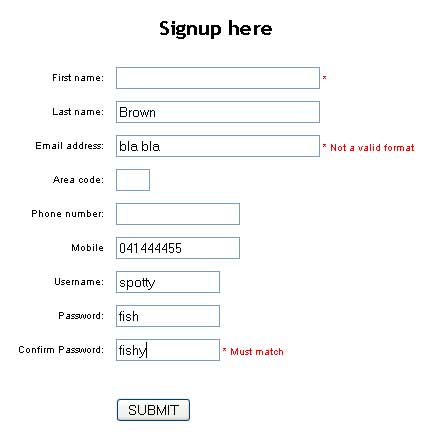
Input Validation Controls

The following controls allow for a variety of validation tasks and can be found in the Validation section of the Toolbox:


"Validating User Input in ASP.NET Web Pages" ( http://bit.ly/LkqfZO )


Required Field Validator

"RequiredFieldValidator Class (System.Web.UI.WebControls)" ( http://bit.ly/xRU49n )

Tuesday, May 10, 2011

EXCEL VBA TOC

Sub CreateTOC()
    '   Code by Zack Baresse
    If ActiveWorkbook Is Nothing Then
        MsgBox "You must have a workbook open first!", vbInformation, "No Open Book"
        Exit Sub
    End If
   
    With Application
        .ScreenUpdating = False
        .DisplayAlerts = False
   
        Dim ws As Worksheet, _
            ct As Chart, _
            shtName As String, _
            nrow As Long, _
            tmpCount As Long, _
            i As Long, _
            numCharts As Long
       
        nrow = 3
        i = 1
        numCharts = ActiveWorkbook.Charts.Count
       
        On Error GoTo hasSheet
        Sheets("Table of Contents").Activate
        If MsgBox("You already have a Table of Contents page.  Would you like to overwrite it?", _
        vbYesNo + vbQuestion, "Replace TOC page?") = vbYes Then GoTo createNew
        Exit Sub

hasSheet:
    Sheets.Add Before:=Sheets(1)
    GoTo hasNew

createNew:
    Sheets("Table of Contents").Delete
    GoTo hasSheet

hasNew:
    tmpCount = ActiveWorkbook.Charts.Count
    If tmpCount > 0 Then tmpCount = 1
        ActiveSheet.Name = "Table of Contents"
       
        With Sheets("Table of Contents")
            '.Cells.Interior.ColorIndex = 4
                With .Range("B2")
                    .Value = "Table of Contents"
                    .Font.Bold = True
                    .Font.Name = "Calibri"
                    .Font.Size = "24"
                End With
        End With
       
        For Each ws In ActiveWorkbook.Worksheets
            nrow = nrow + 1
            With ws
                shtName = ws.Name
                With Sheets("Table of Contents")
                    .Range("B" & nrow).Value = nrow - 3
                    .Range("C" & nrow).Hyperlinks.Add _
                        Anchor:=Sheets("Table of Contents").Range("C" & nrow), Address:="#'" & _
                        shtName & "'!A1", TextToDisplay:=shtName
                    .Range("C" & nrow).HorizontalAlignment = xlLeft
                End With
            End With
        Next ws
       
        If numCharts <> 0 Then
            For Each ct In ActiveWorkbook.Charts
                nrow = nrow + 1
                shtName = ct.Name
                With Sheets("Table of Contents")
                    .Range("B" & nrow).Value = nrow - 3
                    .Range("C" & nrow).Value = shtName
                    .Range("C" & nrow).HorizontalAlignment = xlLeft
                End With
            Next ct
        End If
       
        With Sheets("Table of Contents")
            With .Range("B2:G2")
                .MergeCells = True
                .HorizontalAlignment = xlLeft
            End With
       
            With .Range("C:C")
                .EntireColumn.AutoFit
                .Activate
            End With
            .Range("B4").Select
        End With
   
        .DisplayAlerts = True
        .ScreenUpdating = True
    End With
   
    MsgBox "Done!" & vbNewLine & vbNewLine & "Please note: " & _
        "Charts are listed after regular " & vbCrLf & _
        "worksheets and will not have hyperlinks.", vbInformation, "Complete!"

End Sub


Tuesday, April 26, 2011

Gridview DataBound Event

This event fires once the Gridview has finished Databinding - that is, the Gridview has been populated with all of the data on the Datasource.

Don't get it mixed up with RowDataBound event which fires after each row has finished binding.

This is a great place to run any code that needs to wait until the Gridview is finished binding - perhaps we have been accumulating the values in each row, as they bind & wish to write them out at the end.

"BaseDataBoundControl.DataBound Event (System.Web.UI.WebControls)" ( http://bit.ly/gXWo3S )

Finding controls in the GridView

Because a GridView renders out multiple rows, each of them contain controls with identical names. Finding the right control requires a trick.

For instance, in the RowDataBound/DataBound event, if we were looking for a particular label so that we could write a value to it 'on the fly', we would use the following code:

Dim lblItemotal As Label = CType(e.Row.FindControl("lblItemTotal"), Label)

The CTYPE function is a conversion function. In this case, it will return all of the data associated with the label we are trying to locate, as a Label object. Once located, we can manipulate this particular instance.

GridView TemplateField

The Gridview allows you to add a number of different types of fields.

The TemplateField allows more flexibility in that you can customize the field to a greater degree.


In the example source above, a TemplateField has been used in the Gridview to include an ImageButton. This is a good result, as by default, an ImageButton cannot be included.

This ImageButton has its CommandName property set to 'Increase' and it's CommandArgument property set to the 'CartID' field on the Datasource (the list the gridview is bound to). It also has an ImageURL which is the path to the image to be displayed on the button.


Here is the view of the Gridview fields from within the Edit Column dialogue. There are a total of 4 templateFields used in this example - Total, Increase, Decrease & Remove. Notice that the TemplateFields have a slightly different icon.


In order to edit the contents of the TemplateField, you will need to select the 'Edit Templates' option from the Gridview tasks menu.


Select the template you wish to edit and it will open out for you.


You will notice there are several regions in the template, in this example, I have placed an ImageButton in the ItemTemplate.

Once you have named the control (via the normal Properties pane) and set the ImageURL, open the Tasks menu and select 'Edit DataBindings'.


There are a number of settings we can play with here.

Select the CommandArgument property from the 'Bindable Properties' list and type 'Bind', followed in parenthesis by the field on the datasource to bind.


Check the 'Show all properties' box and now select the CommandName property from the 'Bindable Properties' list and type a name for the command.

Click OK and then from the Gridview tasks menu, select 'End template editing'.

The image below shows the rendered out Gridview.


When the 'Increase' button is clicked in the Gridview, this causes the RowCommand event of the Gridview to fire.

The CommandName string & CommandArgument value are passed to this event for further processing:


Remember that in this example, the CommandName string is 'Increase' & the CommandArgument is holding the CartID.

One thing you see often in this example is the use of  'e'. If you take a look at the parameter list for the event, you can see that the 2nd parameter is called 'e'.

'e' represents a collection of values that hold information about the state of the gridview - including which button was clicked and any CommandName and CommandArgument properties.

As you can see, the first thing happening in this code is the getting of the CartID from the CommandArgument. This is stored in an integer variable.

The next thing you will notice are a series of If statements to determine what the CommandName of the button was. From there, the appropriate code is executed and the CartID is passed along.

ImageButton Class

"ImageButton Class (System.Web.UI.WebControls)" ( http://bit.ly/hguk2A )

Properties of note:
ImageURL:  Gets or sets the URL that provides the path to an image to display

CommandArgument:  Specify a value that can be programmatically read by onCommand event handlers - such as the Gridview. Think, passing a value to a parameter. Optional.

CommandName: Specify a string that can be programmatically identified by onCommand event handlers - such as the Gridview RowCommand event. Optional

FormatCurrency Function

To format a decimal value as currency for output:

lblLabel.Text = FormatCurrency(decPrice)

Also see: Format currency in GridView

Databiding a GridView

 A gridview can 'databind' to any collection/list of objects.

Properties of note:
DataSource - the collection to bind to
DataKeyNames - an array of the field on the datasource to use as the key/identifier (often the Primary Key, in the case of database results). Optional.
Databind - causes the Gridview to bind with the datasource - starts executing other events such as RowDataBound, etc.

Dim myModel As New ModelFacade

gvShoppingCart.DataSource = myModel.getCart()
gvShoppingCart.DataKeyNames = New String() {"CartID"}
gvShoppingCart.DataBind()

In the example above, the getCart method of the myModel object, returns a list. The CartID feild is used as the DataKeyName.